Saturday, July 04, 2020

What excludes terrorist acts?

What is not a "terrorist act" according to Australia's Criminal Code of 1995? According to Australia's anti terror law under their Criminal Code of 1995, a terrorist act does not cover engaging in advocacy, protest, dissent or industrial action where a person does not have the intention to urge force or violence or cause harm to others. Meanwhile, under the Philippines anti terror law Republic Act No. 11479, what shall NOT be considered "terrorism" are the following: Terrorism shall not include advocacy, protest, dissent stoppage of work or industrial or mass action or other similar exercises of civil and political rights, which are not intended to cause death or serious physical harm to a person, to endanger a person;s life, or to create a serious serious risk to public safety. It seems the Philippines only nearly copied what is NOT considered a terrorist act from Australia's anti terror law. In fact what is NOT terrorism, is more expansive under the Philippine anti terror law than that of the Australian anti-terror law.

Tuesday, May 05, 2020

Ban frontliner migration during Covid emergency

I was asked to give a legal opinion to a query in the Office of the President’s Commission on Filipinos Overseas regarding emigrant Filipino health frontliners set to migrate/leave to other countries during this period of national emergency. Section 4, Article II of the 1987 Constitution states: “The prime duty of the Government is to serve and protect the people. The Government may call upon the people to defend the State and, in the fulfillment thereof, all citizens may be required, under conditions provided by law, to render personal, military, or civil service.” Section 5, Article III of the 1987 Constitution states: “The maintenance of peace and order, the protection of life, liberty, and property, and the promotion of the general welfare are essential for the enjoyment by all the people of the blessings of democracy.” On the other hand, the Constitution guarantees certain rights of our people as enshrined in the Bill of Rights. Section 1, Article III of the 1987 Constitution guarantees that “no person shall be deprived of life, liberty and property without due process of law.” Section 6 Article III of the 1987 Constitution guarantees that “the liberty of abode and of changing the same within the limits prescribed by law shall not be impaired except upon lawful order of the court. Neither shall the right to travel be impaired except in the interest of national security, public safety, or public health, as may be provided by law.” Because of the global pandemic brought about by the COVID 19, the government has acted in order to preserve the lives of all Filipinos. Section 23 Article VI of the 1987 Constitution provides that in times of national emergency “the Congress may, by law, authorize the President, for a limited period and subject to such restrictions as it may prescribe, to exercise powers necessary and proper to carry out a declared national policy, unless sooner withdrawn by resolution of the Congress, such powers shall ceased upon the next adjournment thereof.” , Congress has enacted Republic No. 11469, otherwise known as the Bayanihan to Heal As One Act, which declared a natianl emergency and directed the Prsidnet for a limited period to act. Whereas, Section 4(m) of Republic Act 11469, otherwise cited as Bayanihan to Heal As One Act was passed on 24 March 2020, provides, emergency powers for the President to, “engage temporary Human Resource for Health (HRH) such as medical and allied medical staff to complement or supplement the current health workforce or to man the temporary medical facilities to be established in accordance with Section 4 (k) of this Act. Pursuant to the Bayanihan law, the President has issued Proclamation 922 Series of 2020, declaring a state of public health emergency throughout the Philippines, Section 2, of Proclamation 922 series of 2020 provides, “All government agencies and LGUs are hereby enjoined to render full assistance and cooperation and mobilize the necessary resources to undertake critical, urgent, and appropriate response and measures in a timely manner to curtail and eliminate the COVID-19 threat” The Commission Filipinos Overseas (CFO) is an agency under the office of the President, existing pursuant to Batas Pambansa No. 79. Batas Pambansa No. 79 enumerates the powers and functions of the Commission Filipinos Overseas which among others include, to “Perform such other related functions as may be directed by the President or assigned by law.” There are Filipino health professionals such as doctors and nurses who have been contracted by foreign employers, such as among others employers in the United States and other countries, to work in health and medical institutions there, granting such Filipinos immigrant visas. The Commission on Filipinos Overseas, pursuant to registration regulations entitled “Guidelines for the registration of Filipino emigrants and departing spouses and other partners of foreign nationals” dated February 8, 2007 registers these Filipinos as a requirement for migrant Filipinos who intend to leave the Philippines and reside and work overseas. In view of the foregoing, this following comments or opinion is rendered. The Commission on Filipinos Overseas is a government agency attached to the Office of President. It is the legal mandate of the Commission on Filipinos Overseas under Batas Pambansa No. 79 to perform functions as may be directed by the President or assigned by law. These are abnormal times. In fact, there has been a formal declaration of a national emergency by Congress in accordance with the 1987 constitution, and subsequently proclaimed the by the President. The current declared national policy grants express emergency powers for the President to, “engage temporary Human Resource for Health (HRH) such as medical and allied medical staff to complement or supplement the current health workforce or to man the temporary medical facilities”. In fact the President has issued a proclamation directed to all government agencies, and these include the Commission on Filipinos Overseas to render full assistance and cooperation and mobilize the necessary resources to undertake critical, urgent, and appropriate response and measures in a timely manner to curtail and eliminate the COVID-19. During abnormal times, or in this time of national emergency, with more reason should government agencies, more particularly the Commission on Filipinos Overseas, render functions consistent with the orders and directives of the President. Thus, there is a current legal mandate upon the Commission on Filipinos Overseas as a government agency to fully assist and cooperate in mobilizing necessary resources and undertaking critical and appropriate response and measures against COVID-19. This means that all actions undertaken by the Commission on Filipinos Overseas, particularly on emigrant Filipinos connected with the medical profession, like doctors and nurses among others, intending to leave abroad , must be fully in consonance and consistent with the current declared national policy. It must be emphasized that under the Constitution the government can call upon its citizens to render personal, military and civil service. This would include our Filipino medical professionals like doctors and nurses in these times of national emergency. We are aware that Constitutional rights are not suspended even in times of national emergency. The right to life liberty and property, the right to pursue a profession, the right to travel, to leave the country, and the non-impairment of contract clause, are constitutionally guaranteed. Indeed, there are competing interests between the state and individuals pursuing their civil liberties. Yet again, the State has acted upon a constitutional mandate during a national emergency. It is imperative that the Commission on Filipinos Overseas must act in full “assistance and cooperation” with the declared national policy, and directives of the President in a period of national emergency. Thus any act, which otherwise is regularly performed by the Commission under normal times and circumstances, that strays from the declared national policy, should be suspended. It is submitted here that any such suspension does not constitute a grave abuse of discretion on the part of the Commission on Filipinos Overseas. On the contrary, such suspension would be consistent with the Constitution and the laws and the directives of the President. It is submitted that the liberty to travel is lawfully and constitutionally impaired by the enactment of the law declaring a national emergency. In the case of Marcos versus Manglapus [177 SCRA 668 (1989)] the Supreme Court said: “The President has the obligation under the Constitution to protect the people, promote their welfare and advance the national interest. It must be borne in mind that the Constitution, aside from being an allocation of power is also a special contract whereby the people have surrendered their sovereign powers to the State for the common good. In this current situation, there is a law, the Bayanihan To Heal As One Act, that declares a national emergency and authorizes the President to act in response to such national emergency. Thus, with more legal reason is there for the impairment of the right to travel at this time, specifically to those vital “human resources” (frontliners) which are needed in this time of national emergency. There are times when the bill of rights may be subordinated by the mandate of the state under the Constitution to advance the greater national interest. In any event, the same Constitution also mandates that the powers of the President under a state of national emergency is only for a limited period, and not permanent. Hence, these directives are effective during the ‘limited period.” When conditions would later prevail such that there is no more need to address an emergency situation in our country, then the individual’s valued rights under the constitution can be invoked without being infringed. It is noted that the suspension of registration would only be limited to those covered by the Bayanihan Act and the directive of the President, namely human resources i.e. medical professionals who are most needed here during the emergency.

Thursday, October 31, 2013

Hooking up with Greg

I take pleasure in relaying that my very good friend and law school classmate, Greg Macaltao, is doing very well as a businessman in Vancouver. I hooked up with Greg in our recent Vancouver visit just to know how he is doing. I re-connected with him at Facebook and told him I would be in town. We met at a Starbucks outlet inside a grocery store near the place we parked. We had a nice time talking about the past, the present, and the future. Past: Greg was a good friend in law school, a seat mate in fact in Section B. Very good student, and studied at the fourth floor where the Ateneo MBA was housed, from early morning till class time. After law school and a few years of Manila law practice he moved to the U.S. to study masters in business in the U.S., and made a career shift from law to business. Present: He is Vancouver-based now, living near downtown and establishing a start-up export-import business with some partners. He buys goods/products from the Philippines, and ships it to Vancouver for distribution. What the product was, he didn't disclose at that time for superstitious reasons. Future: He hopes to make the first major shipment in a couple of months, and is wishing everything goes well. I'm sure it will. Way to go, Greg...

Tuesday, October 29, 2013

For The Love of Hair

Annie Edison wrote an article on hair loss, that I would like to share: For the Love of Hair There comes a time in every man's life when one has to face up to the inevitable. Dealing with a few more wrinkles and a bit of sagging around the chin is one thing, but facing up to the thought of losing your hair is something else altogether. I've always been secretly proud of my hair, but I have to admit that these days when I look in the mirror I can't help but notice that the tide is a little further back from the shore than it once was. Whilst this leaves me with what I proudly assume is a distinguished looking forehead, there have been times recently when I've been given over to pondering the mysteries of male ageing as a part of my regular musings. This seems to be something with which the Bible has very few comments. Although 2 Corinthians 4:16 has the encouraging statement that "though our outer self is wasting away, our inner self is being renewed day by day", the process of ageing seems to be far less straightforward. More troubling, Proverbs 20:29 tell us that "the glory of young men is their strength, but the splendor of old men is their grey hair". Quite true. But what if the old man doesn't have grey hair? What if he has no hair at all? A Question of Health People really do hate to lose their hair. Psychologists state that in today's world a person's hair is a part of their identity, rather like the clothes that they wear. Losing your hair can mean losing a vital part of how you present yourself to the world. At the same time, there is the inevitable awkward issue about age. Looking in the mirror and seeing your father's face staring back at you is quite humbling, but it's also quite spooky. Nobody wants to feel that they are getting older. If you are a woman, most of these changes happen on the inside so that they are hidden from the world. If you are a man who is going to lose his hair, everyone is going to see. In some cases, as the Hairloss Center experts explain, hair loss is related to health issues such as insulin resistance resulting from too much body weight. Heart disease is another common factor that can increase the risk. For some, it is simply a matter of genetics. Inspirational Figures This made me think about some inspirational people who have no hair, and to look into the stories of their lives. The first names that spring to mind are movie stars. Bruce Willis is a particular inspiration. He grew up as the son of an American soldier father and a German mother, a thoroughly blue collar family background that Bruce has always been proud to affiliate himself with. After the army, his father worked in a factory and as a welder, meaning that Bruce's upbringing in Carney's Point New Jersey was a very normal experience. Bruce himself had a serious stutter, which caused his high school contemporaries to nickname him 'buck-buck' because of his habit of repeating words and sounds twice. Before becoming a famous actor, Bruce Willis worked as a private investigator. Bruce has been a great ambassador for the hairless look. Another actor who has embraced baldness is Patrick Stewart, of Star Trek fame. His portrayal of Jean-Luc Picard in Star Trek: The Next Generation has become the stuff of television legend. Despite being voted television's sexiest man in 1992, Stewart has achieved his highest acclaim for his stage work, particularly Shakespeare. Like Willis, Stewart was born to an army father and a blue collar mother. Unlike Willis, however, Stewart's home life was far from pleasant. His father was a domestically violent man who suffered from shell shock, and who Stewart has described as being a "very potent individual". In recent years, Patrick Stewart has shown that he can resonate with much younger generations by taking a character voice role in the anarchic cartoon American Dad and by embracing the social media networking portal Twitter. Patrick Stewart seems to be an icon for being not letting age get in the way of your life. Unsung Heroes Perhaps the most inspirational of all, however, are those people who aren't famous because of their ability to play an action hero or guide a fictional spacecraft through space. The summer of 2012 saw the Olympics come to London, and one participant really stood out for me. Joanna Rowsell competed in the Olympics as a cyclist at the tender age of 24. Rowsell had won the cycling world cup when she was only 23, and had stunned TV audiences by climbing onto the podium, taking off her helmet, and revealing a completely bald head. Rowsell suffers from alopecia, a condition where the body's immune system attacks the hair follicles, causing the hair to fall out. Joanna Rowsell lost her long auburn hair when she was only ten years old. Despite enduring teasing and taunting at school, Rowsell focused on making herself be the best that she could be physically. In 2012 this paid off when she again climbed onto a podium, this time with the whole world looking on, in order to accept an Olympic gold medal. For me, I don't know how I would cope with going bald. I'd like to think that it would suit me in the way that it does Bruce Willis, or that it would make me look distinguished in the way that it does Patrick Stewart. However, thinking about this whole thing has made me realize that worrying about how we look is so much less important than trying to be the best that we always can be. In a world where people face a daily struggle just to survive, fretting about the hairs on your head is nothing short of a waste of energy. We hold influence through our actions, not by how we look.

Wednesday, October 16, 2013

Bohol's churches

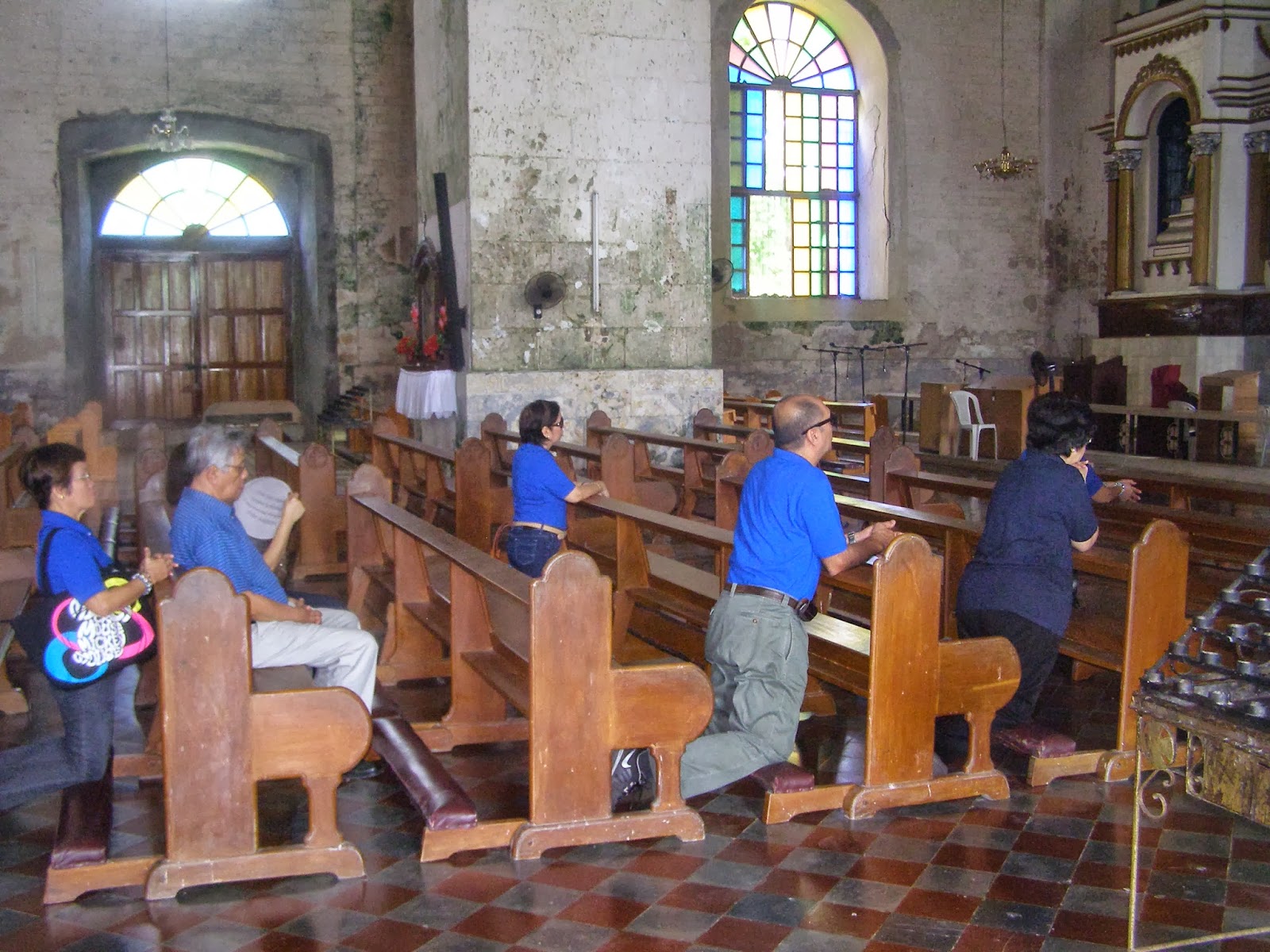
My heart bleeds seeing Bohol’s historical churches felled by nature’s wrath. I suddenly reflected our pilgrimage to some of these magnificent cathedrals a year ago. It seemed God had wanted us to view, visit, pray and commune inside these churches, in all its beauty and splendor, one last time. In Christianity’s history, churches have been conquered, razed, and destroyed. But they are meant to be rebuilt. Bohol’s churches will be restored, certainly. But something tells me, its not going to be the same. Now I realize what a blessing that pilgrimage was.

Tuesday, August 27, 2013

PNoy's P1B 'Pork' in illegal NegOr contracts---COA

Nearly One Billion Pesos of President Benigno Aquino’s ‘Pork Barrel’ officially listed under “Calamity Funds” in 2012 were channeled to illegal infrastructure contracts by the Governor of Negros Oriental, of which half, or P480-million, has already been illegally disbursed, the latest report of Commission on Audit disclosed. On June 5 2012, the Department of Budget and Management issued Special Allotment Release Order No. RO VII -12-0009202 directing the release of P961,550,000.00 from the Calamity Funds, which are part of the President’s discretionary funds in the General Appropriations Act, to the Province of Negros Oriental as implementing agency (IA) to be used for the rehabilitation of rivers, and bridges in Negros Oriental after the massive destruction by typhoon Sendong in 2011 and the earthquake on February 6, 2012. On June 8, 2012, following the issuance of the SARO, P480,775,000.00, constituting fifty percent of the total SARO was deposited to the DBP bank account of the Province of Negros Oriental. However on June 29, 2012, the Department of Budget and Management issued a ‘Negative-SARO”, withdrawing the June 5, 2012 SARO and ordered the Governor to immediately return the deposited amount to the National Treasury and submit the deposit slip evidencing such return. The Province was instead asked to coordinate with the Department of Public Works and Highways for the release of funds to cover the repair of damage infrastructure. The Governor of Negros Oriental, disregarded the order to return the P480,775,000.00, and instead proceeded with the negotiation/bidding and entering of construction contracts with private contractors, amounting to P955,122,944.12 . A total of P480,771,898.58 was disbursed the Province as Implementing Agency and paid to the contractors leaving only P3,101.42. The Commission on audit in its report in 2013 said the contracts entered into by the Province of Negros oriental were illegal because the withdrawal of the SARO by the DBM on June 29, 2012 meant the withdrawal of the allocation. Thus the Province of Negros Oriental as implementing agency could not legally enter into construction contracts. The CoA has issued a Notice of Disallowance and recommended the payment/restitution of the released amount of P480,775,000.00. The Calamity Fund Mess: What happened? On December 17, 2011 typhoon Sendong struck hard Negros Oriental, destroying roads, bridges, and rivers/riverbanks. On February 6, 2012, a massive 6.8 magnitude earthquake hit Negros Oriental claiming lives and destroying major infrastructure, including roads and bridges. Because of these major infrastructure setbacks, the Office of the President directed the release of P961,550,000.00 (or P.961-billion) from the national calamity funds for the repair, and rehabilitation of Negros Oriental roads and bridges. On June 5, 2012, the Department of Budget and Management (DBM) Regional Office in Cebu issued Special Allotment Release Order, S.A.R.O. (No. RO VII-12-0009202). On June 8, 2012, three days after the issuance of the S.A.R.O., a total of P480,775,000.00 was deposited to the account (C.A. No. 740-012666-030) of the Province of Negros Oriental at its DBP Dumaguete branch, under Credit Advice T#740A002, representing the calamity fund from DBM. The DBM regional director Carmela S. Fernan told the Governor of the release, which constituted 50% of the total calamity fund allocation of P961-million. Eleven infrastructure projects were listed for rehabilitation. On June 15, 2012, the Provincial Accountant issued a certification to the availability of the funds. On June 29, 2012, however, the DBM regional director Fernan informed the governor that the SARO for P961-million covering the release of the calamity fund has been withdrawn. (this is called a “Negative-SARO”) The governor was instructed to “return and deposit immediately to the National Treasury” the P480,775,000.00 earlier deposited and submit the deposit slip evidencing such return. In addition, the DBM asked the Governor to “coordinate with the DPWH regarding DPWH requirements and compliance process to expedite the release of funds to support the rehabilitation projects However, the governor did not return the money. Instead, what happened was, the Province continued negotiations and implementation of the eleven projects listed in the withdrawn SARO. On July 30, 2012, eleven contracts amounting to P955,122,944.12 were awarded through negotiation to seven contractors, mostly coming from Albay, Samar, Iligan, under BAC Resolutions 266(A)-12 to 266(K)-12, approved by the governor. On August 1, 2012 Notice of Awards were given to the contractors On August 24, 2012 and September 2014 a total of P143,268,441,59 were given to the contractors as advance payments. A liquidation report was submitted to the auditor for verification of the released amount. On October 9, 2012, a government audit team informed the governor that since the SARO has been withdrawn last June 29, 2012, there was no longer any allotment to cover the contracts, which made these construction contracts null and void, or illegal. On November 29, 2012, the audit team disallowed the disbursement of the P143,268,441,59 advance payment to the contactors. As of December 31, 2012, a total of P238,732,603.20 were already disbursed for the contractors’ progress billings. On March 19 2013, the auditors received an appeal memorandum from the Governor and other persons made liable under the disallowances refuting the disallowances. As of March 1, 2013 (two months before last May elections) the accounting office of the Provincial Government reported a total of P337,503,456.99 already disbursed for progress billings. If we add the advance payments of P143,268,441,59 to the total disbursements (progress billings), the total disbursements amounted to P480,771,898.58. Remember, P480,775,000.00 was deposited June 8, 2012 to the account of the Province, which was ordered to be returned, but not returned. If you deduct P480,771,898.58 (total disbursements) from P480,775,000.00 (deposited, un-returned), what remains is P3,101.42. CoA: P.9B NegrOr infra projects illegal In its latest 2013 audit report, the Commission on Audit (CoA) has found that the P961,550,000.00 infrastructure projects for the repair and rehabilitation of riverbanks and bridges in Negros Oriental are illegal. As a consequence of its audit findings, the CoA has recommended that the provincial government: 1. Stop all on-going projects under implementation pursuant to the awarded contracts amounting to P955,122,944.12; 2. Comply with the Notices of Disallowances (N.D.) which the CoA had issued in 2012 (ND Nos. 2012-139(100) to 2012-149-100(12) of P143,268,441.59; 3. Henceforth, not to make further payments on all contracts relating to the projects of P955,122,944.12. With the finding that the contracts entered into by the provincial government are illegal, there is no more basis to continue with the projects. The problem is that the money has been disbursed already, and there is even a supposed report of “partial accomplishments”. As early as November 29, 2012, the CoA had already issued notice of disallowance on the payments under the illegal contracts. The CoA has explained that a Notice of Disallowance is a written notice issued to the heady of implementing agency, in this case the governor, and concerned officers when a transaction is disallowed in audit for being illegal. The audit disallowance shall be settled by the persons liable through payment or restitution, or by any modes of extinguishment of obligations under the law. A notice of disallowance is subject to an appeal process in case a person is aggrieved by a notice of disallowance. In ruling the construction contracts to be illegal, the CoA said that since the Special Allotment Release Order (SARO) issued on June 5, 2012 by the Department of Budget and Management in the amount of P961,550,000.00, was subsequently withdrawn on June 29, 2012 through the issuance of a “Negative-SARO”, “there was no longer any allotment to cover the contracts”. “Thus, the contracts awarded thereafter, were null and void, and consequently, payment of advances to contractors, and subsequent project billings were illegal,” the CoA said. However, two of the CoA recommendations can no longer be enforced. There is nothing to stop as the projects had long been performed. No payments can be stopped also, as recommended by the CoA, as the payments had long been disbursed and virtually wiped out. If there is a payment that needs to be stopped, it is the remaining P3,101.42, the money left out of the P480,775,000.00 released by the national government to the provincial government. Governor refutes: Negative SARO illegal, criminal However, Negros Oriental Governor Roel De Gamo refuted the Commission on Audit saying the implementation of the projects were in accordance with law. He turned the tables on the CoA saying it was the withdrawal of the SARO, through the issuance of a negative SARO, that was void. According to the governor, withdrawal of the allotment and subsequent issuance of a negative SARO is patently void and criminal, and is a mere political harassment. The governor maintained there was a lawful appropriation of P961,550,000.00 under the 2012 General Appropriations Act, which which fifty percent was released and deposited to the province. The fact that the amount was deposited in the account of the province proves there was lawful appropriation, and availability of funds. He also said that as governor, he is bound under the law to implement and continue to implement the emergency infrastructure projects for the welfare and benefit of the province. The governor also argued that the subject fund is a trust fund and not part of the general fund of the province. Thus the accounting and auditing should be different from accounting the general funds. P.9Billion Calamity Fund is PNoy’s Pork The P961,550,000.00 that has been “illegally” contracted out to various contractors to repair infrastructures damaged by Typhoon Sendong in Negros Oriental, of which P480,775,000.00 has already been released and spent, was taken out of the so called “Calamity Funds”. What is this Calamity Fund? Calamity Funds are public funds that are regularly appropriated under the annual General Appropriations Act. What is the purpose of these Calamity Funds? Calamity Funds have a specific purposed spelled out in the General Appropriations Act: “For aid, relief and rehabilitation services to communities/areas affected by man-made and natural calamities, and repair and reconstruction of permanent structures, including other capital expenditures for disaster operation, and rehabilitation activities,..” “Calamity Funds” is President’s Pork Barrel Calamity Funds are to be released only “upon approval by the President of the Philippines.” Release of calamity funds is upon the discretion of the president, through recommendations from various government agencies like the National Disaster Risk Reduction and Management Council (NDRRMC), and the Department of Health . Calamtiy Funds therefore, is a tiny part of the President’s humongous Pork Barrel in the National Budget. The 2012 General Approproiations Act (Republic Act No. 10155) Under the 2012 General Appropriations Act where this anomalous P.9Billion Calamity fund was appropriated, the use and release of Calamity funds, under Chapter XXXVII of the law, it is stated: “Use and Release of Fund. The amounts appropriated herein may be made available for relief, rehabilitation, reconstruction, and other works or services in connection with natural calamities, epidemics as declared by the DOH, crises resulting from armed conflicts,insurgency, terrorism, and other catastrophes, which may occur during the budget year or those that occurred in the immediately preceding year…”. How is the Calamity Fund Released? According to the General Appropriations Act of 2012 (R.A. 10155), “Releases from this Fund shall be made by the DBM directly to the appropriate implementing agencies upon approval of the President of the Philippines, and in accordance with the favorable recommendation of the NDRRMC …” Negros Oriental: the implementing Agency Records from the Department of Budget and Management show that the Province of Negros Oriental, a local government unit, was made the “implementing agency” for the release of the P961,550,000.00 under Special Allotment Release Order No. SARO RO VII -12-0009202 . Negros Oriental: Not owner, a mere “trustee” of the funds As a mere implementing agency, the Province does not transform to become owner of the Calamity fund. It is a mere “trustee” of the funds, according to the Commission on Audit. The CoA went to the extent of citing the constitutional declaration that “a public office is a public trust” (Supposed to be) When the Department of Budget and Management ordered the return of the money to the National Treasury, did the Province of Negros oriental have the legal right to disregard such directive? The Commission on Audit says the Governor should have returned to the national treasury the released portion of the calamity funds amounting to P480,775,000.00 . It is the Funds, the release of which is subject to the President approval. The governor, on the other hand says the order for the return through the “negative-SARO, is illegal, and even criminal. Status The CoA has issued Notice of Disallowance, meaning the amount released and spent (P480,775,000.00) by the Governor must be restituted. The Governor appealed this CoA position.

Friday, August 16, 2013

CoA: P.9B NegrOr Calamity projects illegal

In its latest audit report, the Commission on Audit (CoA) has found that the P961,550,000.00 infrastructure projects for the repair and rehabilitation of roads and bridges in Negros Oriental are illegal. As a consequence of its audit findings, the CoA has recommended that the provincial government: 1. Stop all on-going projects under implementation pursuant to the awarded contracts amounting to P955,122,944.12; 2. Comply with the Notices of Disallowances (N.D.) which the CoA had issued in 2012 (ND Nos. 2012-139(100) to 2012-149-100(12) of P143,268,441.59; 3. Henceforth, not to make further payments on all contracts relating to the projects of P955,122,944.12. It can be recalled that in June 2012 Department of Budget ordered the release of P961,550,000.00 from the national calamity funds to for road and bridge repairs in Negros Oriental. Fifty percent, or P480,775,000.00 was deposited to the account of the Province. However the order for the release of the funds was withdrawn and the governor was ordered to return to the national treasury the fifty percent that had been deposited, or P480,775,000.00. The governor did not return the money and instead proceed with the awarding of contracts for eleven projects, to contractors most of whom are based in Albay. All the P480,775,000.00 has already been wiped out, or disbursed save for P3,101.42. With the finding that the contracts entered into by the provincial government are illegal, there is no more basis to continue with the projects. The problem is that the money has been disbursed already, and there is even a supposed report of “partial accomplishments:. As early as November 29, 2012, the CoA had already issued notice of disallowance on the payments under the illegal contracts. The CoA has explained that a Notice of Disallowance is a written notice issued to the heady of agency, in this case the governor, and concerned officers when a transaction is disallowed in audit for being illegal. The audit disallowance shall be settled by the persons liable through payment or restitution, or by any modes of extinguishment of obligations under the law. A notice of disallowance is subject to an appeal process in case a person is aggrieved by a notice of disallowance. In ruling the construction contracts to be illegal, the CoA said that since the Special Allotment Release Order (SARO) issued on June 5, 2012 by the Department of Budget and Management in the amount of P961,550,000.00, was subsequently withdraw on June 29, 2012 through the issuance of a “Negative-SARO”, “there was no longer any allotment to cover the contracts”. “Thus, the contracts awarded thereafter, were null and void, and consequently, payment of advances to contractors, and subsequent project billings were illegal,” the CoA said. However, two of the CoA recommendations can no longer be enforced. There is nothing to stop as the projects had long been performed. No payments can be stopped also, as recommended by the CoA, as the payments had long been disbursed and virtually wiped out. If there is a payment that needs to be stopped, it is the remaining P3,101.42, the money left out of the P480,775,000.00 released by the national government to the provincial government.

P.9 Billion NegOr Calamity fund mess exposed

A nearly One Billion Peso anomaly has been reported in connection with the rehabilitation of roads, and bridges in Negros Oriental after the massive destruction by the typhoon Sendong in 2011, and the 2012 killer earthquake in Negros Oriental. This one billion peso Negros Oriental anomaly has, so far, been the ‘mother of all anomalies’, that has reduced the controversial multi-million peso PDAF-bogus NGOs scam, as mere peanuts. Here is what happened: On December 17, 2011 typhoon Sendong struck hard Negros Oriental, destroying roads and bridges. On February 6, 2012, a massive 6.8 magnitude earthquake hit Negros Oriental claiming lives and destroying major infrastructure, including roads and bridges. Because of these major infrastructure setbacks, the Office of the President directed the release of P961,550,000.00 (or P.961-billion) from the national calamity funds for the repair, and rehabilitation of Negros Oriental roads and bridges. On June 5, 2012, the Department of Budget and Management (DBM) Regional Office in Cebu issued a “release-money-order”, technically called Special Allotment Release Order, commonly referred to as S.A.R.O. (No. RO VII-12-0009202). On June 8, 2012, three days after the issuance of the S.A.R.O., a total of P480,775,000.00 was deposited to the account (C.A. No. 740-012666-030) of the Province of Negros Oriental at its DBP Dumaguete branch, under Credit Advice T#740A002, representing the calamity fund from DBM. The DBM regional director Carmela S. Fernan told the Governor of the release, which constituted 50% of the total calamity fund allocation of P961-million. Eleven infrastructure projects were listed for rehabilitation. On June 15, 2012, the Provincial Accountant issued a certification to the availability of the funds. On June 29, 2012, however, the DBM regional director Fernan informed the governor that the SARO for P961-million covering the release of the calamity fund has been withdrawn. (this is called a “Negative-SARO”) The governor was instructed to “return and deposit immediately to the National Treasury” the P480,775,000.00 earlier deposited and submit the deposit slip evidencing such return. The governor did not return the money. Instead, what happened was, the Province continued negotiations and implementation of the eleven projects listed in the withdrawn SARO. On July 30, 2012, eleven contracts amounting to P955,,122,944.12 were awarded through negotiation to seven contractors, mostly coming from Albay, under BAC Resolutions 266(A)-12 to 266(K)-12, approved by the governor. On August 1, 2012 Notice of Awards were given to the contractors On August 24, 2012 and September 2014 a total of P143,268,441,59 were given to the contractors as advance payments. A liquidation report was submitted to the auditor for verification of the released amount. On October 9, 2012, a government audit team informed the governor that since the SARO has been withdrawn last June 29, 2012, there was no longer any allotment to cover the contracts, which made these construction contracts null and void, or illegal. On November 29, 2012, the audit team disallowed the disbursement of the P143,268,441,59 advance payment to the contactors. As of December 31, 2012, a total of P238,732,603.20 were already disbursed for the progress billings. On March 19 2013, the auditors received an appeal memorandum from the Governor and other persons made liable under the disallowances refuting the disallowances. As of March 1, 2013 (two months before last May elections) the accounting office of the Provincial Government reported a total of P337,503,456.99 already disbursed for progress billings. If we add the advance payments of P143,268,441,59 to the total disbursements (progress billings), the total disbursements amounted to P480,771,898.58. Remember, P480,775,000.00 was deposited June 8, 2012 to the account of the Province, which was ordered to be returned, but not returned. If you deduct P480,771,898.58 (total disbursements) from P480,775,000.00 (deposited, un-retruned) what remains is P3,101.42. The balance is not even enough to buy a decent cell-phone. The wipe-out of the account was sweeping and forceful as the typhoons and earthquake that devastated the people of Negros Oriental. Last May 13, Governor Roel De Gamo was elected governor of Negros Oriental for another three years. Congratulations! God Bless the People and the Province of Negros Oriental!

Saturday, July 28, 2012

The piano and my past Some people say the best things in life are free. In many ways, I find it true. A few days ago, I dropped the Yupangco building along Buendia looking for an electronic keyboard that a brother-in-law wanted to buy. The Yupangcos, I learned are one of the biggest dealers of musical instruments in the Philippines. Upon entrance to their grand store, what immediately caught my eye was this grand piano, that was extraordinarily large. That was the first time in my life I saw such grand piano of such size, "in the flesh", so to speak. I was so excited I had my picture taken right beside it, like perhaps having my-self photographed with a superstar. In the picture, I thought I looked more like a piano salesman. I interviewed the lady in the store. I was shocked to hear its purchase price: P14-million pesos (US$333,000). Is there a piano costing that much, like that of  a Porsche? The lady responded, its P14-million because it old. The brand new costs P25-million. If you rent it, it  costs P50,000, she added. My goodness, I said. "Will you charge me if I touch it?" I asked The lady responded, "You can play even for free, if you know how." "Really?" I asked, beaming. Go ahead, she responded I lost no time. I sat down and played "How Lovely Is your Dwelling Place by Fr. Arnel Aquino." And I was in awe, listening  to the sound of each ivory key that I pressed. It has been decades since I stopped playing the piano regularly, but I had a kid-feeling that moment, like I have never felt in a long long time. I felt I was in a recital, savoring the sound of that piano reverberating throughout that  sprawling  Yupangco showroom. After I did the piece, the store lady relayed to me the people who had rented and used it in the past, like David Foster and Ryan Cayabyab. It was quite a pleasant afternoon. Even for just a moment, I rekindled one of the nicest feelings of my childhood, which was performing at a piano recital. That elegant grand piano became a time-machine, taking me to my distant past, relieving my musical memories. The bonus part, I played the 'grandest' piano, at no cost at all. Indeed, the best things in life are free.

Sunday, May 13, 2012

Mother, the greatest blessing What is God’s greatest, most significant gift to you? To this question, I never hesitate an answer. In my world, the greatest gift God has given me was that which I received the moment I was born--- my mother. My mother is Marlen Icamen Dejaresco, daughter of Christian missionaries, a teacher, government worker, most of all a loving, devoted and faithful wife and mother to me and four siblings. I have had brilliant, learned teachers, mentors all through my life. But none of them equals the knowledge and wisdom imparted to me by my mother. She taught me how to read the Bible at a very early age. The simplest things to learn in life is to know what is right and wrong. We make so many choices in life, some of them good, some bad, some right, some wrong. But that is the essence of our humanity—we are not without sin. Nevertheless, it sure has been helpful that many choices I made are guided by what was taught me by my mother even before I entered kindergarten. I treasure those Bible stories of Joseph the Dreamer, Jacob the Deceiver, David the Goliath slayer, Daniel the lion-tamer Zacchaeus the tree-climbing, reformed cheater. I learned of Jesus calming the storm in front of frightened followers. I first heard those true stories from my mother. I tell you , my mother tells true stories like no media person can. My mother is my greatest advocate. I am confident she would defend me, and be by my side no matter what. I tell you, she would defend me like no lawyer can. My mother is the ever-reliable physician. When I got sick, she was there to take care of me. She ensured I take my medicines. She even bought me an expensive ozonizer so that my family would be as healthy, as we can be. I tell you, my mother cares for her children’s health like no doctor ever can. I was happy growing up with my mother. She bought me new shoes. She took brought me to Maricar’s to eat that unforgettable spaghetti, after her work. We ate ice cream at Dainty (where Jollibee Alfonso XIII is now located). I remember those ice cream pints sliced into half. Or we went to cool off at Snow White (with no dwarfs) beside the bell tower. I’m blessed I felt a mother’s love . She loves us, her children like no person ever can. No doubt, God’s greatest gift to me is my mother. So, it would be fitting to say thanks to my mother for all things good, and happy. Happy mother’s day, mama.

Tuesday, January 10, 2012

Angels amidst Sendong's wrath?

Pilar Benitez, a sister in the Brotherhood of Christian Businessmen and Professionals tells an inspiring story of unwaivering faith in the midst of the devastation by typhoon Sendong in Iligan City. Here's her account:


Dear Brothers and Sisters,

Let me just share with you a heartwarming story of faith and trust in our Father. As you know, Holcim has a cement plant in Iligan, thus quite a number of our employees were affected by typhoon Sendong. Most of them, lost their homes & property, while others lost relatives and friends. Now that the holidays are over, our Manila-based Iligan residents have reported back to work, they all have their stories to tell, and here is one of them:

At the height of typhoon Sendong, several residents found themselves jumping from one roof to another frantically trying to save themselves. A group of about 60 congregated on top of a large house and they settled there for the night. Most of them were BCBP members while quite a number were from Couples for Christ and a muslim family. The rain kept pouring hard, it was pitch black and all you could hear were desperate cries for help. Below them, these 60+ people could see that most of the houses were under water and those that remained were either washed away by the flood or were destroyed by the hundreds of logs that came crashing down with the muddy water.

In the midst of this chaos, our brothers and sisters came together and started praise & worship. Their prayers and their songs could be heard above the din and the noise of houses being smashed against each other. The muslim family did not join in prayer but kept crying out in desperation. One of our brothers approached them and invited them to pray - and they did. Across the street, there were several people also on top of roofs who could hear our brothers & sisters in prayer.

The next day, this same people across the street, told our brothers & sisters that their house was spared because they could see that there were several men in front of the house that kept pushing away the logs that came crashing down. Who were these men? And could ordinary men have the strength to push away these huge pieces of tree trunks? They didn't think so.
It seems that their angels were working over time that night! The power of prayer. The majesty of our God. God is truly a faithful God!

Let us continue to include in our prayers all our brothers & sisters in Cagayan, Iligan and in Compostela Valley.

Sunday, January 01, 2012

Hope for the New Year

Friends,
We wake up to a new year full of trials and uncertainty.
But having had a Christmas break that was truly worthwhile and full of meaning, we are re-charged.
For your good deeds, I pray with confidence God will shower you with abundant blessings this coming year.
Giving is always a blessing.
In our native language, “Sa inyong pagka-matabangon, ang Ginoo na’y mag-igo.”
I am not praying for more disasters, but I hope you will continue extending a helping hand to others in distress.
In the meantime, as we face fresh challenges in the coming year, my wish for all of us is that spoken in the old Irish blessing…
May the road rise to meet you,
May the wind be always at your back,
May the sunshine warm upon your face,
The rains fall soft upon your fields and,
Until we meet again,
May God hold you in the palm of His hand.
Happy New Year.

Sunday, December 25, 2011

TRO effective sans compliance of conditions

My Christmas eve celebration was spoiled a bit by a disturbing read of a dissenting opinion of the Supreme Court that I am attaching.
http://sc.judiciary.gov.ph/jurisprudence/resolutions/2011/december2011/199034_sereno.htm

I am referring to the dissenting opinion of Justice Maria Lourdes Sereno in connection with the petition of Gloria Macapagal Arroyo seeking to leave the country (G.R. Nos. 199034 and 199046).
The Sereno dissent, promulgated just eleven days ago on December 13, 2011, is unprecedented in several ways.

First, I got a front seat ticket to the internal, behind-closed-doors discussions of the Supreme Court.

Second, I just learned tonight that one of the very basic and long-observed rules on issuances of Temporary Restraining Orders has just been overturned by this Supreme Court.
The basic rule is, if a condition in a TRO is not met, the TRO does not take effect.
I have experienced in law practice not observing a TRO, when one of conditions imposed by the court is not complied with.
This is a very basic procedure.
However, the Supreme Court has overturned this in its November 29, 2011 resolution in ruling that “the TRO is not suspended despite non-compliance with a condition”. I read this in Sereno’s dissent.
This resolution will have serious repercussions in the way lawyers practice law.
This means that even if a condition in a TRO is not complied with, the TRO is still effective.
But what disturbs me more is the flip-flop of the Supreme Court in arriving at this conclusion, based on the narrations of Justice Sereno.

Third, I just learned tonight there is suppression of freedom of speech in the Supreme Court even on its own justices.
The dissent of Justice Sereno was refused publication upon directives of the Chief Justice.
This is also the first time in my law practice that a dissenting opinion is much feared, to the point that it is refused publication and/or dissemination, to the prejudice of the public’s right to know.

Fourth, this is the first time I learned that it is possible to dissent to a dissenting opinion, or to make a “counter-dissent” as Justice Sereno puts it.
I recall in law school a case we read where a lawyer was castigated by the Supreme Court for filing a motion for reconsideration to a dissenting opinion.
A dissenting opinion is supposed to be what it is--- an opinion that dissents to a main opinion.

Its been an educational Christmas eve for me.

Friday, December 23, 2011

Christmas in our hearts

Christmas is in the air.
But we must make sure Christmas is in our hearts too.
The true spirit of Christmas is giving.
But this time, giving should not be in the nature of exchange gifts.
So many have been distressed because of the devastation brought by typhoon Sendong.
Just yesterday, we received stories that the affected hinterland areas of Valencia, particularly Palimpinon, Puhagan, Mala-unay, Pulang-bato have been isolated from ordinary transport that is why relief has come a little slow.
This Christmas, the Lord is giving us a golden opportunity to celebrate the season the way it should be celebrated.
We are witnessing so many brothers and sisters suffering because of the typhoon.
We visited barangay Batinguel and Candau-ay and around 250 families there will be spending Christmas in the classrooms and sleeping atop desks.
We went to the wake of a family, the Balbon-Calijan family of Tubtubon Sibulan, six members of whom perished because of the typhoon’s merciless wrath.
It is a heart-wrenching, chest-crumpling story.
It is a difficult struggle already to loose a loved one.
How much more six family members at the same time, and worse, at Christmas?
The survivor-husband Nimuel Calijan, weeping in front of an array of coffins, summed it all: “This is like a terrible dream.”
This week, we saw the face of tragedy.
On the happy side, our eyes saw the generosity of many willing to help.
We also witnessed the eager response of kind hearted- individuals who just gave what they could to ease the pain of those who suffer.
“There was a call, so we came to help,” said one doctor bringing a box of relief items.
God does not physically come down from Heaven to give aid to the distressed.
He uses those fortunate to be spared as instruments to implement His works of mercy.
But the destruction is so overwhelming, that we need more help.
We suggest that you organize your group, your peers, your classmates, officemates, and team up to give.
There are still many others whose shoulders just need to be gently tapped, so they can extend help.
Sometimes, they are just waiting for someone to initiate.
Believe it or not, you and your friends can create your own little miracle, and see the spectacle of God’s amazing grace.
Let’s continue to give this Christmas.
Give without ceasing.
With that, we can truly say Christmas is in our hearts.
From my family to yours, Merry Christmas.

Monday, October 31, 2011

Ageless Jose Mari Chan


The other night, we watched a concert-for-a-cause featuring Jose Mari Chan titled “Constant Care” at the cozy open-air venue of Panglao Nature Island Resort in Bohol.
The affair is a project of the radio network of the Bohol Chronicle, under the flagship of DYRD in Tagbilaran City.
DYRD is marking its golden anniversary after fifty years of broadcast service.
DYRD first went on the air in October 1961.
It has been fifty years of radio activity starting from wirecasting to internet broadcasting.
One of the highlights of the anniversary is a concert for the benefit of Inyong Alagad, the longest running public service radio program of the station providing assistance to indigent residents of Tagbilaran and other Bohol towns.
It was a night of nostalgia.
Jose Mari Chan belted out a treasure trove of his classic hits beginning with “Big Beautiful Country”
This song begins with the lyrics “Welcome world, to this big beautiful country…”
His debut in the recording industry was his first hit single “Afterglow” in 1967.
This was a time when, as a young musical artist, Jose Mari Chan would literally bring a bunch of ‘45’ records (played then on turn tables) and would do the rounds in radio stations pleading to disc jockeys to play his new record.
The concert was also sponsored by Philippine Airlines, so Jose Mari Chan paid tribute to the flagship carrier by singing the commercial of PAL which he composed in the 1970’s titled “Love at Thirty Thousand Feet.”.
Until today, the melodic tune of PAL is played not only in media commercials but as inflight background instrumental while passengers await to soar in the air.
Jose Mari Chan is widely recognized as one of the nations most prolific balladeer.
He is known as Mr. Songwriter. He is engaged by the nation's top advertising companies owing to his ability to create catchy radio/tv jingles and commercials.
He sang one-by-one his music and romance he wrote through the years including Deep In My heart, Tell Me Your Name, Beautiful Girl.
An innovation in the concert was to select local female talents of Bohol to do the duets with Jose Mari Chan.
A talented Tagbilaran pediatrician ably replaced Regine Velasquez in “Please Be careful with My Heart”
A locally-based registered nurse did not lag in musical ability in “You’re my Girl, My woman, My Friend” which, Jose Mari Chan related, he wrote for the wedding of his sister.
The most touching love songs were those that sprang his true-to-life love experience.
In his bachelorhood, he was heart broken when his girl friend left for Osaka to do missionary work.
In his loneliness, he wrote “Refrain” which was a smash when it was recorded and released in the market.
He said he considered “Refrain” as his “winning” song, among his array of hits, because with this song he won the heart of his girlfriend, who later became his wife.
His beautiful wife, who could easily fit the pretty lass, in the song Beautiful Girl, is Mary Ann Chan who was seated at the front row, occasionally signaling him to wipe the sweat off his face in between songs.
When he was about to celebrate his eighth weeding anniversary with his wife, he was suddenly transferred by his sugar trading company from New York to London.
He had heavy feelings about leaving his wife and family in New York.
Although destined to go to a faraway place, he wanted to assure his wife of his lifelong commitment, thus the song “Love to Last A Lifetime” was written, and eventually it became another song for the charts.
Before he sang the song, he recited the lyrics like a poem which I realized can be appreciated as pleasantly.
Capping the concert were the two of his most famous Christmas melodies “Perfect Christmas” and “Christmas in our Hearts”
“Christmas in our Hearts” is a duet with daughter Elizabeth Chan, but that night the audience willingly did the duet part.
I had promised my sister Ellen to call her while she lay in her hospital bed in Manila when Jose Mari Chan sang “Perfect Christmas” and “Christmas in Our Hearts” so I obliged, and “re-broadcast” it to her direct . It was Christmas in the air at that moment.
It was prophetic too, as Ellen would again have another ”Perfect Christmas” in December (Merry Christmas, Len)
I must admit, I have been a Jose Mari Chan fan for a long time.
In the few stacks of cd’s in the car, two of them are albums of Jose Mari Chan.
He is , to me a national treasure.
No one comes to close when it comes to creating ear-catching radio jingles.
He is one of the great modern Filipino musicians because his songs are ageless.
His melodic creations resonate only too well with the Filipino’s musical taste.
"Christmas in Our Hearts” is a classic example.
Many of us watching him live were all the more endeared witnessing his undying passion not only for music, but also his burning desire to share and showcase his abundant talents to his fellowmen.
Young and old, know the lyrics of his creations.
He has a multi-generational following.
He is an entertainer where a grandparent and grandchild can enjoy watching together.
Indeed, Jose Mari Chan, is a musical talent for the ages.

Saturday, October 08, 2011

Needed: Jobs at Apple

Sad to learn: No more Jobs at Apple

Wednesday, April 27, 2011

My goodness, the Bulls are Back


After the end of the reigning Bulls dynasty in the nineties, I have lost interest in the NBA.
This morning I was casually watching the Bulls-Pacers Game 5 first round playoffs, and suddenly I felt getting into a time warp back to the nineties saga.
Michael Jordan is right. Derrick Rose is going to be a star.
Rose, NBA rookie of the year awardee, already played in the All-Star this year.
A Chicago native, Rose sparks the Bulls rampaging offensive.
The Bulls’ burly men provide a solid defense Joakim Noah, veteran Kurt Thomas, Sudanese Luol Deng, Carlos Boozer and Kyle Korver.
The Chicago Bulls has re-built a formidable team in just a decade, and has quietly crept its way to the top once again.
I think I’ll be watching more NBA basketball.

Sunday, April 17, 2011

Credit card charges: only 2% monthly

In the Philippines the Supreme Court has declared that credit card charges should only be two percent (2%) per month or twenty-four percent (24%) per annum.
This drastically reduces the contractual stipulation by credit card companies, which impose as high as one hundred eleven percent (111%) of interest, penalty and finance charges on credit card holders.
Based on contract, credit card companies can charge as high as 9.25% per month, broken down as follows:
Every month the credit card company slaps card holders with three percent (3%) interest .
In addition, another three percent (3%) imposed for penalty charges.
In addition, another 3.25 % percent is imposed for finance charges, for a total of 9.25% per month.
In one year, that could accumulate to 111% additional charges.
Thus, if you have a principal obligation of P100,000 to the credit card company, in one year, your debt can accumulate to more than double the principal amount.
This is just a ball bark figure (more or less) because we are not talking about monthly compounding of these charges, if this is in the contract..
The Supreme Court said these charges are too much.
“We are of the opinion that that the interest rate and penalty charge should be equitably reduced… to 2% per month or 24% per annum,” The Supreme Court said.
Courts are authorized by law to reduce interest and penalty charges if the court believes that the contractually agreed charges are unconscionable.
Under our example, if the credit card debt is P100,000.00, after a year, the total debt can accumulate to only around P124,000.00, more or less.
If you are in default in your credit card payments, and the credit card company slaps you will all sorts of charges, you can argue that the additional charges should only be two percent (2%) monthly.
It would also be advisable if the card holder go as far back in his/her bills so he/she can seek a re-computation at a rate of two percent (2%) per month in past statements of account.
[Ileana DR Macalinao versus Bank of the Philippine Islands, G.R. No. 175490, September 17, 2009.]

Friday, February 25, 2011

Life Insurance Beneficiary

I got an interesting query on life insurance.
Here is the situation:
Tatay lived a colorful life. In his lifetime he had a legal wife and children.
Later tatay separated from his legitimate family and lived with a paramour.
Tatay and paramour bore a child named R-Jay.
While living with paramour, Tatay got a life insurance naming his paramour and their minor illegitimate child R-Jay as beneficiary.
Tatay died.
Two groups now seek to claim the proceeds of Tatay’s life insurance.
First, the legitimate family members (wife and children) claim they are entitled to the insurance proceeds being the legal hers.
On the other side is paramour (with her illegitimate child R-Jay) claiming they are entitled to the proceeds since they were the named beneficiaries.
The question posed to me was: who gets the insurance proceeds, the legitimates, the paramour and her child, or share in accordance with rules on succession?
There is a rule taken from American law that whoever is named as beneficiary gets the life insurance proceeds.
Insurance proceeds are likened to a donation, a gift out of liberality.
In our case, paramour is disqualified from becoming a beneficiary of a life insurance, even if she was expressly written as one.
The mandate of Article 2012 of the Civil Code cannot be laid aside: any person who cannot receive a donation cannot be named as beneficiary in the life insurance policy of the person who cannot make the donation.
The Civil Code also bars donations between common law spouses (not married).
“Policy considerations and dictates of morality rightly justify the institution of a barrier between common law spouses in record to Property relations since such ultimately encroaches upon the nuptial and filial rights of the legitimate family,” said the Supreme Court.
The legitimates cannot also receive the insurance proceeds.
Life insurance proceeds out of special contract.
With a beneficiary, the proceeds will not belong to the category of “inheritable” items.
It is only in cases were there is no beneficiary or when the beneficiary is disqualified by law to receive the proceeds that the insurance policy proceeds shall redound to the benefit of the estate of the insured.
So it is the illegitimate child R-Jay who is entitled to the insurance proceeds.
“No legal prosprciption exists in naming as beneficiaries, children of illicit relations by the insured,” said the Supreme Court.
But since R-Jay is still a minor, someone, likely the paramour (mother) should have herself appointed by the court as legal guardian first.
Until the court appoints a guardian in behalf of the minor illegitimate, the insurance company can withhold the release of the check.

Friday, February 11, 2011

Angelo T. Reyes: Lessons learned

There are many lessons to be learned from the tragic death of Angelo T. Reyes, former Armed Forces Chief of Staff and Defense Secretary.
Reyes, who served government for almost half a century, shot himself Tuesday after hearings in the senate and congress linked him to anomalies in the Armed Forces.
Reyes plunged deep into depression after having been publicly pilloried in the senate hearings.
He himself revealed there was a concerted effort to destroy him.
When the public humiliation extended to his family, he wouldn’t allow it.
One of the lessons which I hope will be addressed is the way congressional investigations are conducted.
I once worked as a lawyer in this Blue Ribbon Committee more than a decade ago.
Things were different then.
Senators participating in blue ribbon hearings accorded respect to their resource persons.
Unfortunately, over the years, things have turned for the worst.
Resource persons, invited to senate house investigations are instantly converted into virtual accused, even criminals.
Senate investigations have become an arena for political grandstanding, headline-grabbing, power-tripping and ego enhancement, and personal vendetta.
This is not the kind of senate hearing that our constitution envisioned.
Senate hearings have a specific purpose, that is, it must be in aid of legislation, not in aid of persecution.
One of the changes we want to see in the senate is the imposition of restraint in the treatment of resource persons because these invitees come not as persons accused in a criminal case.
Senate hearings should not be likened to a police interrogation.
The best way to learn how to conduct congressional investigations properly is to watch C-SPAN coverage of U.S. congressional investigations (unfortuntately you will not see a Jinggoy Estrada manner of questioning there).
We wish to see changes in the manner of treating resources persons who invoke the right against self incrimination.
This is a very important constitutional right which insulates a person him from becoming a witness against himself.
Yet, I have sensed that this constitutional protection has been emasculated by senators who feel discomfort every time a guest invokes this right.
Again, the senate is not an arena for criminal investigation that is why leeway must be given to guests who invoke the right to refuse to be a witness against himself.
What is happening is that the senators will have to evaluate every time a resource person invokes this right.
The senators will determine whether the availment of the right by the resource person was proper.
In the United States, resource persons in congressional investigations are respected when they invoke the Fifth Amendment.
The Fifth Amendment of the U..S. Constitution is the counterpart guarantee against self incrimination.
This is in recognition of long-recognized supreme court interpretation that the privilege against self incrimination extends not only to answers that support a conviction of a crime, but also those which merely furnish a link in the chain of evidence needed to prosecute a claimant for a crime (Hoffman versus United States 341 U.S. 479)
Since a senate investigation is not a criminal inquisition, the senate should leave criminal probes to proper bodies like the office of the ombudsman and the department of justice and just focus on the proposed legislation being considered.
What is happening is that when a resource person invokes his right against self incrimination, the senators will insist in forcing the recourse person to give an anticipated answer already lingering in the legislators’ minds.
And if unsuccessful, they threaten the resource person with contempt and deprivation of liberty.
Worse they threaten to bring their family into the hearing.
What kind of legislative investigation is that?
I believe the sacred right against self incrimination that protects all of us individuals is being unconstitutionally diluted and emasculated in congressional inquiries.
I hope the death of Angelo T. Reyes will serve as a constant reminder that congressional inquiries should not endanger individual liberties and tromp personal dignity.
Legislators should not demean themselves and the institutions they represent.