skip to main |
skip to sidebar
I have encountered this question not a few times: Why is libel a criminal offense? In the first, place why is libel punishable? What is bad about libel?Libel is bad because it unduly wrecks the honor of another person. It is a person's honor that is being protected by libel laws. That is why inherently, libel is bad and is punishable.One cannot just call another a thief, a smuggler, son-of-a-bitch, adulterer, and other similar ill-attributes. If one does that to another, he will likely face legal consequences.As a matter of fact, lawyers will say that libel is something that the constitution does not protect. While there is freedom of speech under our constitution, it does not protect libelous speech, just like obscene speech is not protected.But the question is, if libelous speech has to be punished under the law, why is it made criminal?Under Philippine law, libel is punishable under the revised penal code. This means that one can go to jail if he is convicted of libel. The jail term for one count of libel is between six months and one day to four years and two months. If one is convicted of several counts of libel, he may not be eligible for probation, and thus may serve jail time.There is one journalist who has been slapped a jail sentence of more than thirty years for libel. It is now on appeal before the Supreme Court.Historically, libel is a very serious offense against political authority. For instance when kings and monarchs ruled, subjects or commoners cannot speak ill or bad things about the king otherwise, his toungue will be cut. That was if the libel speaker wasn't hanged.History therefore, tells us that libel is an offense that is met with severe conseuqence by authority.The belief is that a man's honor is his priceless treasure. He may be poor materially, but his honor is his his prized possession.Honor was precious then. It is now.If this is the case, then why not just require the person guilty of libel to compensate the person he defamed--intead of criminal punishment---anyway, it is the individual's honor that is being attacked?The reason why libel is considered a criminal offense is because libel can lead a person to commit a "serious breach of the peace."Libel, it is believed, can disturb the peace and tranquility of society. That is why libel has to be an offense not only against the person defamed, but to the state and society as well.If you visit the slum areas, you hear one neighbor accuse another "put_ _ g-ina-mo!". You can expect a bolo-chasing scene. That is a classic libel-as-breach-of-the-peace scenario.It is believed a person defamed or libeled may commit violence (in the olden times, it can lead to a duel) if there is no adequate punishment that society imposes upon the defamer.This is the belief at common law.Until now, this remains the belief, and remains an insitutional policy under our system because it is still in the revised penal code.There are moves in congress, as strongly advocated by journalists, to "decriminlize" libel.To decriminalize libel, means that the jail term for the guilty will be removed. Only civil, monetized damages will be the means to compensate the person defamed.Actually, to decrminalize libel is to reject and overturn and age-old concept that libel can lead to a serious breach of the peace.There are those who disagree with decriminalizing libel because this will only drive the defamed, many of whom are monied and influential people, to use other means of retribution, and would not be willing to go through a lengthy civil process that gives no assurance of vindication.This is a real danger of decrimiminalizing libel. Even at this time when libel is still a criminal offense, many journalists are being murdered.Will decriminalizing libel reduce the number of journslists murdered? Or will it just exarcerbate the situation?Second, we must remember that the criminial libel law is not the exclusive concern of journalists.Journalists are not the only persons accused of libel. Libel covers broad spectrum which involves situations that do not involve the press. There is libel involving private persons concerning matters of purely private concern (i.e. neighbors defaming each other with graphic invectives). Should this be also included in the sweeping bandwagon for libel decriminalization?Yet the only ones talking about decrminilization of libel are the journalists, creatinga flase impression that the crime of libel is their exclusive domain.This is where Congress, the policy makers, come in.Their duty, it should be remembered, is to maintain that critical balance between the interests of protecting private reputation viz-a-viz the need to promote freedom of speech. Congress must look deeper into the subject of libel decriminlization.It must look beyond the concern of journalists.The fear is that a sweeping decriminalization of libel might create an imbalance between the need to protect private reputation and the need to protect constitutionally-guaranteed free speech.With an imbalance, our society will revert, and is bound to suffer the conditions which precisely led to criminalizing libel: a breach of the peace.
This may be difficult to believe, but the Philippine legal system accords greater accommodations in the matter of protecting free speech interests agasint defamation suits. Based on Philippine jurisprudence, in defamation cases that involve political speech, the issue is not limited to the status of the plaintiff or complainant, but rather, as to whether or not the matter is one of public interest.In the Philippines, courts look not only on the status of the plaintiff i.e. whether public official, public figure or private individual, in balancing free speech interests with the need to protect a person's reputation.A recent decision by the Philippine Supreme Court walked the extra mile for the press by not only using the status-of-the-plaintiff standard, but also the "public interest" standard. The Supreme Court has ruled that the issue also to be considered in defamation litigation, is whether or not the subject matter that led to the defamation case is one of which the public is interested.In short, the question to be resolved in defemation cases is: Is it a matter of public concern?This was the declaration of the Supreme Court in the case of Arturo Borjal versus Court of Appeals (1999).This case involved a private individual who sued a columnist, the late Arturo Borjal, for defamation.The Supreme Court in that case categorzied the suing plainitff as a public figure. Being such, the matter had to be decided based on the actual malice standard. The actual malice standard prohibits public officials and public figures from recovering damages for defamatory falsehood pertaninig to their official or public conduct, unless the they prove that the statement was made with actual malice, that is, with knowledge of its falsity or with reckless disregard as to whether or not it was false.But beyond this, the Supreme Court proceeded to declare that so long as the subject matter that led to the defamation case was a matter of public interest, the actual malice standard is applicable.To quote the Supreme Court:"But even assuming ex-gratia argumenti that private respondent, despite the position he occupied in the FNCLT, would not qualify as a public figure, it does not necessarily follow that he could not validly be made subject of a public comment even if he was not a public official or at least a public figure, for he could be as long as he was involved in a publc issue. If a matter is a subject of public or general interest, it cannot suddenly become less so merely because a private individual is involved or because in some sense the individual did not voluntarily choose to become involved. The public's primary interest is in the event; the public focus is on the conduct of the participant and the content, effect and significance of the conduct, not the participant's prior anonymity or notoriety."Thus the issue to be resolved is not limited only as to who was involved, but "what" was involved.The Arturo Borjal case, in effect ressurrected the rule in Rosenbloom versus Metro Media decided by the United States Supreme Court.In Rosenbloom, the actual malice standard was applied by considering not the status of the suing plaintiff, but the interest the incident had upon the public.Subsequent to the Rosenbloom decision, the United States Supreme Court underwent a re-thinking process and thought that there should not be a blanket application of the actual malice standard without looking into the status of the plaintiff.That is why in the United States, a lesser requirement is need for plaintiffs who are neither public officials or public figures, before they can recover damages.For instance, in the U.S., a private individual plainitff, i.e. not a public official or public figured, is required only to establish fault and falsity in order to recover damages for defamatory publications.In effect, the Rosenbloom doctrine was set aside by the United States Supreme Court.Yet, in the Philippines, the Supreme Court has validated the Rosenbloom doctrine and upheld the rule that the type of speech involved should be looked into in resolving libel suits.Thus, on this score, Philippine jurisprudence has given more accomodation to constitutional value of political speech. In our jurisdiction, it is not just the status of the plaintiff which will determine the appropriate standard to be applied, but also the interest that the subject matter generates to the public at large.
First Gentleman Miguel Arroyo is merely exercising his right to file a libel case against journalists whom he believes have unjustly and unlawfully maligned what he believes is his good name and reputation.After all, according to his son, the good congressman from Pampanga, "he deserves to be hurt."Thus, laws in criminal libel are available for the First Gentleman to avail and seek redress.What is disturbing though are the pronouncements of the Frist Gentleman's lawyer, Atty. Ruy Rondain on national television who pre-emptively proclaimed that his client is "not fair game."This may sound inocuous, but from a legal standpoint, this is calculated to pre-emptively categorize the First Gentleman as as "private individual" in contrast to being a "public figure."In defamation litigation, there is a whale of a difference between a private individual-complainant or plaintiff, and a public figure-complainant or plaintiff.The private individual-complainant or plaintiff will meet a lesser burden in recovering damages or proving libel than the public-figure-complainant or plaintiff.It is noted that the First Gentleman is seeking a uniform P10-million civil damages.To be able to recover such damages, and to be able to attain a conviction, the First Gentleman's legal team is already advancing their argument that their client, the complainant, is a "private individual-complainant" or plaintiff, and not a public figure-complainant or plaintiff.They sanitize this crucial issue in libel by describing the First Gentleman as one who is "not fair game."The standards in defamationPublic official or public figureOur Supreme Court has adopted the docthe trines in defamation that have been promulgated by United States Supreme Court.Jurisprudence has adopted and applied the concept that public officials and public figures have to meet the "actual malice standard" in order to recover damages, or to be able to prove criminal libel beyond reasonable doubt.These have been decided by the ruling cases of New York Times v Sullivan, Curtis Publishing v. Butts, Garrison v Louisiana (U.S. Supreme Court Cases); and the cases,. among others of Rodolfo Vasquez v Court of Appeals, Arturo Borjal Jr. v Court of Appeals, Ciriaco Boy Guinguing v Court of Appeals, Salvador Flor v Court of Appeals, (Phlippine Supreme Court cases)Just to recall, the actual malice standard prohibits a public official or public figure from recovering damages for a defamatory falsehood relating to official conduct unless such statements were made with actual malice, that is, with knowledge of its falsity or with reckless disregard of whether or not it was false.Private individualBut in the matter of private invidividual-complainants or plaintiffs, the standard to be applied and burden of proof is much less than the where the complaint or plaintiff is a public official or public figure.In the United States, case law mandates that those plainitffs who are neither public officials or public officials are not required to meet the actual malice standard in order to recover damages.In the case of Philadelphia Newspapers Inc v Mauruice Hepps, the United States Supreme Court ruled that a private individual who files a suit against a newspaper on a matter of public concern need only to prove falsity or fault, in order to recover damages.Crucial IssueIt will therefore be a crucial issue in libel litigation instigated by the First Gentleman, as to whether or not he is to be categorized as a public figure or a privatge individual. What are the standardsThe First Gentleman or his lawyers is therefore, beating his opponents to the draw by pre-emtively positioning the complainant as a private individual.But is he really a private individual-complainant, or a public figure-complainant, so as to apply the actual malice standard? Is he fair game or not?The answer to this issue can be culled from the recent decisions of our Supreme Court because it has made definite classifications as to the kind of plainitiffs who initiate libel cases.In the instructive decision of Arturo Borjal v Court of Appeals, the Supreme Court categorized the planiitff in a suit for (civil) libel, Francisco Wenceslao as a public figure and therefore was tasked to prove actual malice. The plaintiff there was the executive director of the First National Conference on Land Transport, an entity created to solve the massive transport problem in Metro Manila during the Cory administration. In that case, the Supreme Court considered him to be a public figure, and not a private individual, and thus must meet the actual malice standard.In the recent case of Ciriaco Guinguing v Court of Appeals, the Supreme Court categorized the complainant therein, Mr. Choy Torralba, as a public figure and must also be tasked to prove actual malice before a libel conviciton can be pronounced.In that case, the complainant was a Cebu broadcaster, and businessman. The Supreme Court said this classifies the complainant as a public figure.What about the First Gentleman?If an executive director of a relatively not very well known entity, or a media broadcaster can be classified as a public figure in matters of defamation litigation, how much more the First Gentleman, who is defintely more than just the President's personal photographer.The First Gentleman exactly is not one who has hidden behind the curtains of public discussion and debate. He has been the prime mover in public activities such as the Southeast Asian Games. He has been at the forefront in working for the welfare of overseas Filipinos. And not long ago, he literally thrust himself into the arena of public recognition by climbing the boxing ring when Manny Pacquaio clobbered the terrible Mexican Erik Morales in Las Vegas, where the First Gentleman received a not-so-friendly reaction from Filipinos watching the world over.A public figure in defamation litigation has been described as one who thrusts himself into the arena of public discussion and debate. He is one who has easy access to media to be able to inject his ideas and to counter criticisms.The first Gentleman has been seen in practically all major media outlets filing cases of libel. He has been intereviewed by media where he countered the attacks against him by his adversaries.And now his legal team says he is not fair game?They must be playing games.
Mass and public transport in Hongkong is so efficient that one can easily travel around the narrow-lane streets. First, is the railways or what they call the MTR. This is the equivalent of Manila's MRT, only the Hongkong MTR is all over the region, and can take a passenger from one point to another at a very fast speed. If you want to try the MTR, I suggest you go to the central station where the coaches will take you even to the farthest place, including the border station in Lo Wu, which welcomes you to Shenzen, China.
 Another feature of the MTR of Hongkong is their Airport Express. This feature provides a more convienient way coming to and from the highly acclaimed Hongkong International Airport. As a traveller, you can check-in your luggage through Airport Express at certain designated stations away from the airport. You don't have to go to the airport to check-in your luggage. The catch is, you need to take the MTR in going to the airport if you use the Airport Express check-in, which costs HK$100 (P650).If you take the double-deck bus to the airport, it will cost you around HK$21 (P165) per passenger, including children. It is of course a longer trip to the airport (around 45 minutes from central), than the MTR. If you want to view Honkongand you are not in a hurry, take the bus.
 Then there are the yellow double-decker busses which is the most common mode of land transport in and around the main coomercial districts, and even beyond. The buses in Hongkong are very much unlike the public buses in Manila. Hongkong public busses are much cleaner, cooler and more convenient to ride on. They follow the number system where the busses have their own numbers corresponding to designated bus stops.
 In Manila, the buses race against each other and stop even in the middleof the road unmindful of other motorists. You don't see that in Hongkong. The explanation there, is of course, conomics, but that is another story.Also notable are the lack of polluted smoke emitted from the mufflers of Hongkong public buses.
 Aside from the double deck buses, there are the 16 seater mini buses that have their own specific routes.The tram is the cheapest way to travel in the inner commercial streets in Hongkong. It costs only HK$2.00 (equivalent to around P15.) per ride regardless of distance. It is like a monorail in the middle of the street that stops at certain corners and station in the busy commercial district. It is open air, unlike the more expensive buses, which charges depending ont he distance.The taxis in Hongkong are the red Toyota Crown Comfort. It seems that they were specifically ordered from Toyota because they are all alike. You immediately notice it is very spacious at the back.They are strict in Hongkong in terms of number of passengers allowed. They limit only five passegners per cab. By the way, it is right-hand drive in Hongkong. The cabs are all automatic transmission.The flagdown rate is HK$15 (around P90.00) But it takes a very long time before the meter starts ticking.But once it begins to tick, at HK$1.40 (around P9.00), it ticks after just a few hundred meters.Be aware, if the driver discovered your unfamiliarty of the place, you just might be in for a joyride. I'm speaking of experience.
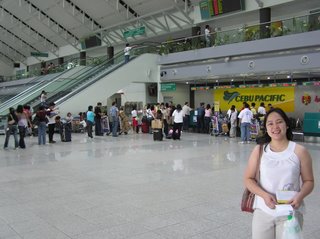 Last August 25, 2006 I attended the Media Summit in Kidapawan, province of North Cotabato, initiated by the Publishers Association of the Philippines.I was to conduct a talk on libel and the recent legal developments.My wife Ruby accompanied me.From Dumaguete City, we went to Cebu to take a plane ride to Davao abord Cebu Pacific. From Davao we were to take a two hour ride to Kidapawan.
 The journey compelled us to spend the night in Davao, due to our flight schedule. We arrived in Davao from Cebu at 7 p.m. already on August 25, 2006. So out land trip had to be the next day.There were quite a few impressive things new we encountered in Davao.We saw the spanking Davao Ingternational airport, arguably one of the best in the country.
  We also stayed in a brand new hotel in downtown Davao, named the Las Casitas. It was lesss than a month since it was inaugurated, so the facilities were quite new.If you intend to stay in Davao you can get in touch with Las Casitaqs de Angela at 185 Rizal Street., Davao City. Reservations at tel (082)227-5130 / (082) 224 - 0945.
 The prices were reasonable and was perfect for us since we were only staying for the night, which was only around twelve hours.The following morning, a Saturday, we took a taxi to SM Mall where we were supposed to be fetched by chartered bus.Apparently, we arrived late and the bus had left already, so we took a van. The fare from Davao to Kidapawan was P140.
 The venue of the Media Summit was the brand new Grand Ficus Hotel, owned and personally managed by Dodong Lu.Grand Ficus is the place to stay when in Kidapawan.It has fine facilities and amenities for relaxation and even for conferences and professional activities.
 After the Kidapawan affair, we took the van again for a two hour trip back to Davao. Again we spent the night at Las Casitas before proceeding to Davao International Airport for our return trip to Cebu.At the airport, we met some of the participants of the Media Summit who were also bound for Cebu.I can see a huge and growing market for the Davao Cebu leg of these airlines as Cebu has become a major regional destination outside Metro Manila.
 Passengers are those who come from Mindanao and intend to go to other places int he Visayas region, not necessarily in Cebu. In our case we were headed for Dumaguete City. The friends we met in the airport were bound for Samar and Leyte.